
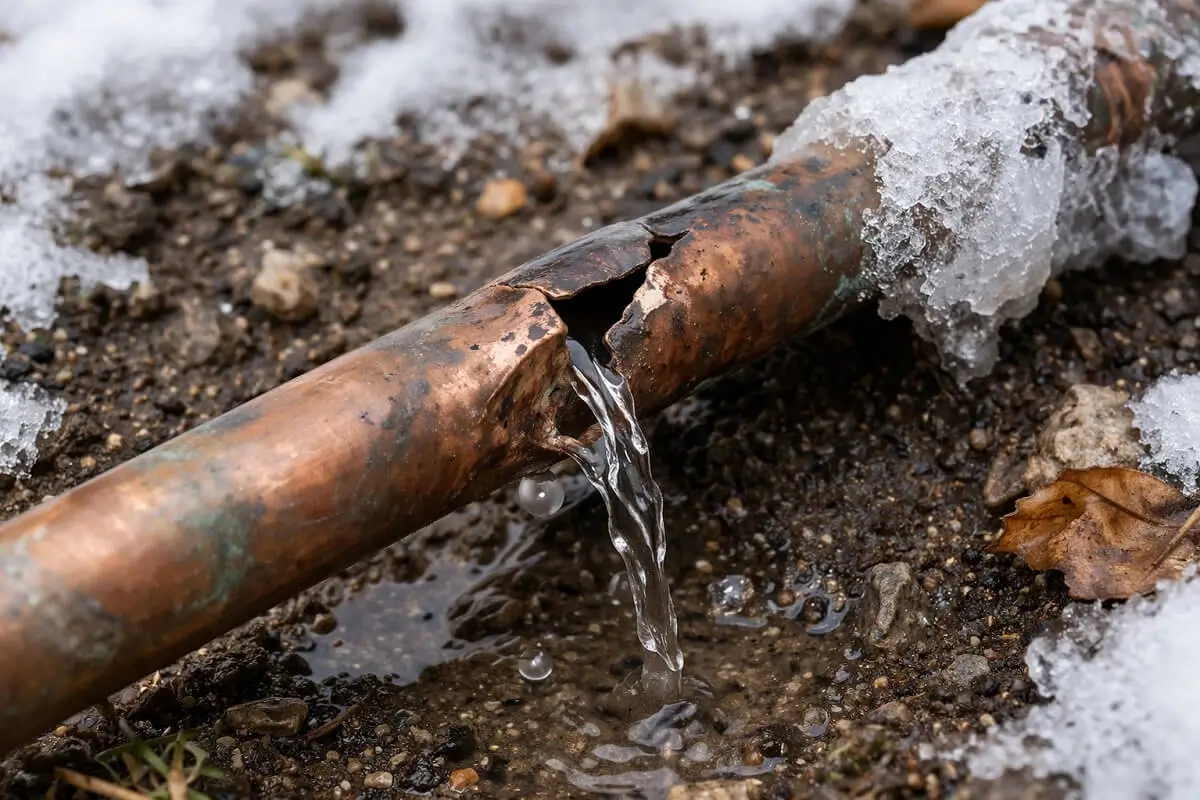

Do you still believe that pipes burst at the exact moment the water inside them freezes? It sounds logical: water turning to ice, expanding, and forcing cracks to develop in the pipes. But that’s rarely how damage truly unfolds. In Pottstown and Berks County, nights often drop below freezing while daytime temperatures rise above it. The result?
Over time, microscopic cracks form, remaining invisible until the weather outside changes and often requiring advanced leak detection services to identify the source early. When a sudden spring warm spell arrives, frozen pipe damage finally surfaces. Given how it affects the entire plumbing system, many homeowners consider scheduling a professional plumbing inspection after winter to detect hidden weaknesses before they worsen.
What Happens Inside a Pipe During the Freeze?
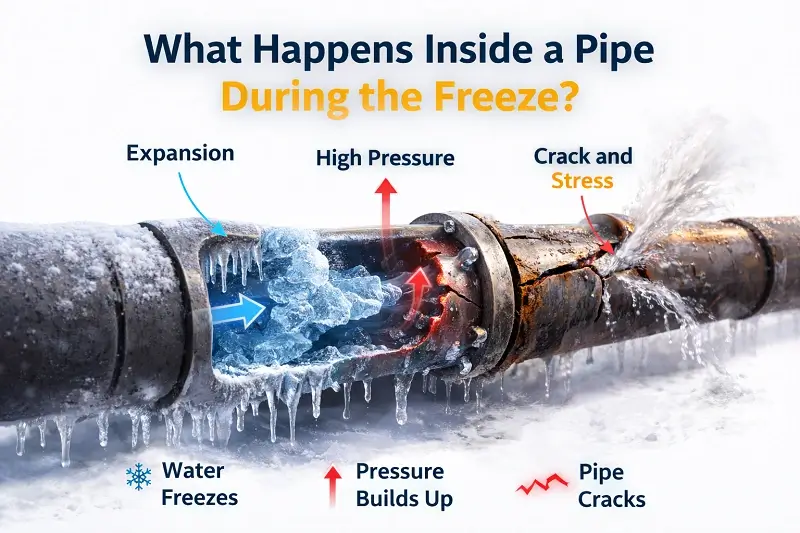
Living in a freezing state like Pennsylvania, it wouldn’t be surprising if you continue to wonder why pipes burst in cold weather. According to Physics 101, when the temperature falls below the freezing point, the damage inside your house’s plumbing system begins quietly, without any visible signs. It’s not an instant explosion; it’s a mechanical stress process happening within confined spaces. The rupture, if it happens, is usually the final stage of mounting internal strain, not the beginning.
Here’s what transpires inside the pipes!
- Water expanding while freezing: Due to its unique molecular structure, water expands when its temperature drops to the freezing point by nearly 9%.
- Expansion increases internal pressure: Once ice blocks a section inside the pipe, water gets trapped between the two frozen parts. Extremely high pressure develops within, which is far beyond what these residential pipes can handle.
- Pipes stretch beyond tolerance: Under such a high amount of internal force, the pipe walls begin flexing under stress, even if no visible damage appears. Even if you won’t see any visible deformity, the stress force on the material is beyond the safe limit.
- Weak spots begin forming: hairline fractures at joint connections, any form of previous wear, or areas with minute manufacturing variations render the pipes most vulnerable.
How Thawing Temperatures Make Damage Worse
Even when the mercury level drops far below the freezing point, your kitchen’s pipes or the fixtures underneath the foundation slabs won’t burst open. Yes, winters create internal stress, and that too in excess. But it is the thawing phenomenon that triggers structural failures. Once temperatures start rising, physics changes drastically. Rather than melting uniformly, ice melts in sections. Thus, water flow pathways are reopened but unevenly, causing sudden pressure redistribution.
Here’s why thawing is one of the major causes of burst pipes.
- Trapped water is suddenly released in pockets once partial ice blockages are cleared, thereby creating abrupt pressure changes within the pipes.
- Water flow gets resumed forcefully against previously frozen sections, which intensifies strain at weaker areas.
- Expanded pipe walls don’t always return to the original dimensions during uniform thawing.
- Once the water pressure normalizes during the spring, seams and fittings that once endured freezing pressure fail.
Burst Pipe Causes That Develop After the Cold Spell
Not all burst pipe causes can be traced back to any freezing night in particular. In Pottstown and Berks County, the entire winter season triggers recurring freeze-thaw cycles, which is why stress compounds within the plumbing systems. During every cycle, pipe materials expand, contract, and restabilize while being exposed to fluctuating physical pressure. The failure that you notice during late winter or early spring is the result of weeks of gradual weakening.
Having said that, let’s explore the most common reasons why pipes burst after the cold spell.
- Internal pressure spikes repeatedly due to continuous temperature swings. With each freeze-thaw cycle, the walls get stretched by nanometers, which reduces long-term material resilience.
- While copper has high pressure tolerance compared to other materials, repeated expansion and contraction phenomena gradually weaken its structural integrity over time. Over time, it causes longitudinal splitting.
- PVC, owing to its low temperature tolerance, becomes brittle during winter. Thus, pipes of this material often have microscopic hairline fractures, which expand once water pressure returns.
- Couplings and soldered/crimped fittings fail faster than the straight pipe sections due to concentrated stress during the freeze cycle.
- Once frozen, water exerts outward pressure, existing corrosion deepens, and structural deformation accelerates.
Why Plumbing Problems Appear Weeks Later?
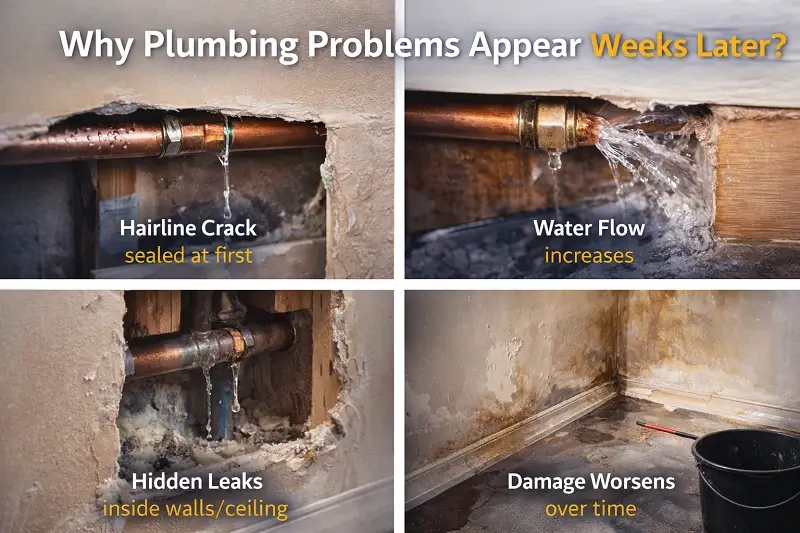
Once the cold waves pass, homeowners in Pennsylvania, particularly in Pottstown and Berks County, encounter plumbing problems after winter, but not immediately. This delay isn’t accidental; beneath it lies structural physics. Here’s how the delayed timeline unfolds.
- Hairline fractures that were formed during the freeze-thaw cycles remain sealed at first. However, with continuous pressure and temperature normalization, they expand gradually and cause leakage.
- Once full water flow resumes due to the melting of frozen sections, standard operating pressure puts unexpected stress on the already compromised portions. It often leads to material separation, especially at joints.
- Pipes concealed behind the walls, ceilings, or insulated surfaces often leak without any visible signs, keeping the issue masked for days.
- What usually begins as minor dampness eventually saturates drywalls or flooring, making freeze-related pipe damage to the structural integrity more noticeable.
The cycle continues, and with each day, the damage worsens. Many homes in Pottstown and Berks County may experience pipe bursts or leaks during late winter and early spring. That’s why consulting a plumbing inspection specialist right after the freeze-thaw cycle, the first week of spring in particular, can make these hiccups avoidable.
Pennsylvania-Specific Risk Factors
Regional climate patterns and housing characteristics of Pottstown and Berks County introduce the greatest risks of pipe leak after freezing. Here’s how.
- Extended sub-freezing causes frost to penetrate deeper into foundations, thereby exposing the deep-seated pipes to prolonged cold stress.
- Rapid overnight freezes followed by daytime thaws intensify dimensional deformity inside the pipe walls.
- Plumbing systems in Pennsylvania houses built decades ago are already structurally fatigued.
- Older copper-based plumbing systems are more susceptible to metal fatigue after recurring freeze-thaw exposure.
How Do Professionals Detect Hidden Pipe Stress?

The plumbing problems after winter rarely announce themselves early. That’s why professional assessment is crucial in Pottstown and Berks County, as it can:
- Expose sections unable to withstand standard operational loads through controlled pressure testing
- Pinpoint microscopic fractures inside the pipe walls by using acoustic and thermal imaging tools
- Assess structural integrity and connection points by utilizing internal camera systems
Conclusion
Freeze-thaw cycles render the pipe materials fatigued from the inside out. It often leads to delayed reveal of burst pipe causes, like repeated expansion, internal pressure shifts, and gradual structural weakening. Understanding how temperature swings affect pipe integrity will allow you to act earlier and reduce system-wide failure risks. A seasonal pipe evaluation after winter, especially in freeze-prone regions like Pottstown and Berks County, can help you pinpoint hidden vulnerabilities before they drain your pocket for repairs.