


Hot water usually runs out fast for one of a few common reasons: sediment sitting in the tank, a heater that’s too small for your household, a worn heating element, or a cracked dip tube. A water heater works in three basic steps. It pulls in cold water. It heats that water with a burner or electric element. Then it holds onto the hot water until you turn on a tap. A lot of homes across Reading and Berks County are still running on tanks sized decades ago. That’s a big part of why this comes up so often here.
You’re the second one in the shower and the water’s already gone cold. Or the dishwasher’s running, the laundry’s going, and there’s nothing left for anyone else. This is different from a heater that’s stopped heating altogether. If yours has gone completely cold or won’t turn on at all, that’s a separate issue. We cover it in our hot water heater not working guide. This one’s for the heater that still works, just not for long enough.
We hear this from homeowners all over the county — West Reading, Sinking Spring, Wyomissing. It almost always comes down to one of a few things.
How Does a Water Heater Actually Work?
Before we get into what’s going wrong, it helps to know what’s supposed to happen in the first place.
Cold water comes in through the dip tube. Water from your home’s supply line enters the tank and travels down a plastic tube to the bottom, where the heating actually happens. A burner or heating element warms it up. Gas units use a burner underneath the tank. Electric units use one or two heating elements inside it. Either way, the coldest water gets heated first. The thermostat keeps the temperature steady. It watches the water temperature and switches the burner or element on and off to hold roughly the same setting all day. Hot water rises and comes out the top. Hot water is lighter than cold, so it naturally floats to the top of the tank, where the outlet pipe pulls it whenever you turn on a hot tap. Tankless units skip the storage step. Instead of holding a tank of water, a tankless system heats water the instant it flows through. It uses a much stronger burner or element to do that. There’s no standing supply to run out of. But it’s still limited by how fast it can heat water on the fly.
What Causes Hot Water to Run Out So Fast?
Once you know how the system’s supposed to work, the causes make a lot more sense.
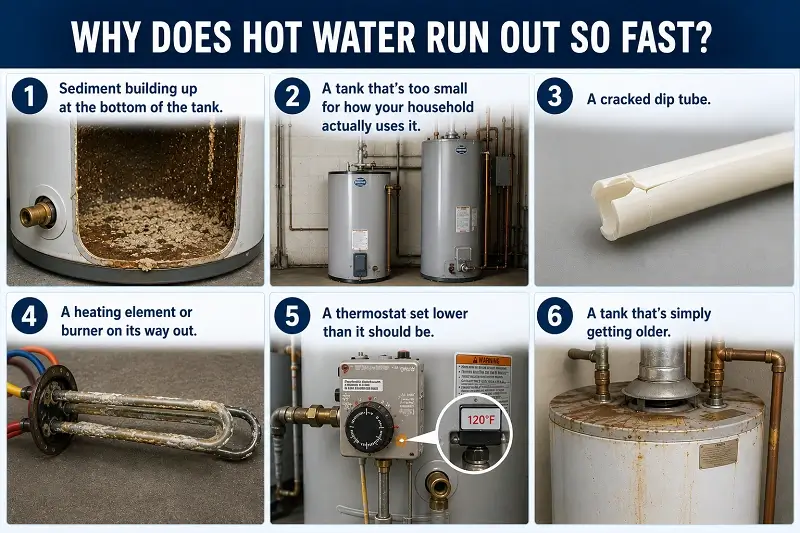
Sediment building up at the bottom of the tank. As water heats, minerals settle out and collect at the bottom. Berks County’s municipal water runs mineral-heavy, and a lot of homes here still rely on private wells. Both speed up sediment buildup compared to many other places. A thick layer of sediment eats into your usable hot water and makes the unit work harder for less of it.
A tank that’s too small for how your household actually uses it. A tank that was plenty when you moved in can fall behind over time. The household grows, you add a bathroom, or everyone’s shower and laundry schedules start overlapping.
A cracked dip tube. Remember that tube that keeps cold water separate from hot? When it cracks, cold water starts mixing in near the top instead of the bottom. What comes out of your tap turns lukewarm faster than it should. This one usually shows up suddenly rather than gradually.
A heating element or burner on its way out. On electric units, one of the two heating elements can fail, cutting your hot water supply roughly in half. On gas units, a weak or dirty burner just can’t bring the water back up to temperature fast enough between uses.
A thermostat set lower than it should be. Sometimes it’s this simple. The setting may have drifted, or someone turned it down at some point. Either way, the tank isn’t heating the water hot enough to begin with — and this one’s usually the easiest fix to make.
A tank that’s simply getting older. Past a certain point, internal parts wear down. The tank can’t recover heat between uses the way it used to, no matter how well you maintain it. We’ll get into the specifics of when age becomes the real problem a little further down.
Watch for rust-colored water, rumbling or popping from the tank, or a shortage that’s crept up gradually over months. Any of these point more toward sediment or age than a random one-time glitch.
How Can I Make My Hot Water Last Longer?
If your setup is otherwise in decent shape, a few habits go a long way.
Flush the tank once a year. This clears sediment before it turns into a real capacity problem. If you’re on well water, flushing every 8 to 9 months is worth the extra effort.
Spread out your high-demand tasks. Showers, laundry, and dishwashing back to back will empty a tank faster than spacing them a bit further apart.
Switch to low flow fixtures. Low-flow showerheads and faucets stretch the hot water you already have.
Keep the thermostat around 120°F. That’s generally the sweet spot for comfort, safety, and not wasting energy heating water hotter than you need.
Consider upsizing or going tankless if your household has outgrown the tank. No amount of maintenance fixes a heater that nobody sized correctly for what you’re asking it to do. Our tankless vs. tank water heaters guide walks through which one actually fits a bigger household.
For a deeper dive, check out 10 tips to make your hot water heater more energy efficient.
How Do I Know If I Need a Repair or a New Water Heater?
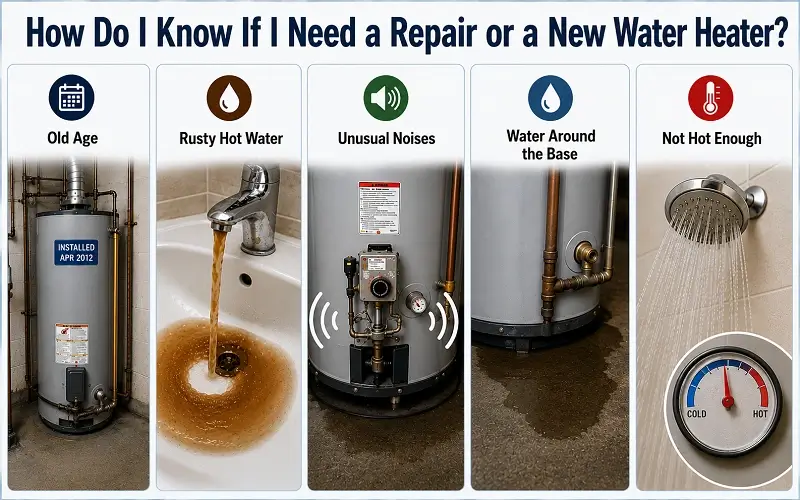
Don’t wait for a cold shower to find out something’s wrong. Watch for:
The tank is past 10 to 12 years old, especially if you’ve never flushed it. Hot water only, and it’s coming out rust-colored. Popping or rumbling sounds coming from the tank itself, usually sediment hardening near the burner. Water pooling around the base of the unit, which points to a tank leak rather than a loose fitting. Water that’s inconsistent or lukewarm even right after the tank finishes heating.
Any one of these is worth a look from a water heater repair technician. Two or more together, and it’s probably time to call rather than wait it out.
Ready to Stop Guessing Why Your Hot Water Runs Out?
Whether it’s sediment, a tank your household has outgrown, or a worn-out part, the fix is usually more straightforward than it feels. It just doesn’t feel that way in the middle of a cold shower.
Whether you need a repair, a full water heater replacement, or just an honest answer about what’s going on — our licensed team is here. We’re available 24/7 across Reading, PA and all of Berks County.
Call (484) 332-3573, available 24 hours a day, 7 days a week. Or contact us online to schedule your water heater assessment.
Frequently Asked Questions
1. Why am I suddenly running out of hot water so fast?
A sudden change, rather than something that’s been getting worse slowly, usually points to a cracked dip tube or a failed heating element — not sediment. A quick diagnostic visit will tell you which one it is.
2. How long should a water heater tank actually last?
It depends on maintenance and water quality more than anything else. See the warning signs above. Tank age is one of the biggest ones to watch for once you’re past the typical lifespan.
3. Is it normal to run out of hot water faster in winter?
Yes. The groundwater coming into your home is colder in winter, so the tank has to work harder to reach the same temperature. A heater that’s already borderline will feel it first.
4. Do tankless water heaters ever run out of hot water?
Not in the traditional sense, but they’re still limited by flow rate. Run several hot water fixtures at once and you can outpace what the unit can heat in real time. Our Tankless vs. Tank Water Heaters guide covers sizing for bigger households.
5. Can I replace a dip tube myself?
It’s not something we’d recommend as a DIY project. Draining the tank, disconnecting the cold water line, and seating the new tube correctly without introducing leaks or air pockets takes the right tools and some practice. It’s usually a one-visit fix once a plumber’s already there for a diagnostic check.