


A garbage disposal that’s humming, tripping its reset, or dead silent is usually dealing with a jam, an overload, or a motor that’s starting to fail. Some of these are safe for a homeowner to check in a couple of minutes; grinding without spinning, leaks, burning smells, or repeat resets are not and mean it’s time to call a plumber. Homes on well water and septic systems, common across rural Berks County, put more strain on a disposal than a fully municipal setup, so trouble can show up sooner here than it does elsewhere.
You flip the switch, and instead of that familiar grind, you get a hum, a click, or nothing at all. Before you decide whether this is a two-minute fix or a job for a professional, it helps to know what’s actually going on under your sink.
What Causes a Garbage Disposal to Stop Working?
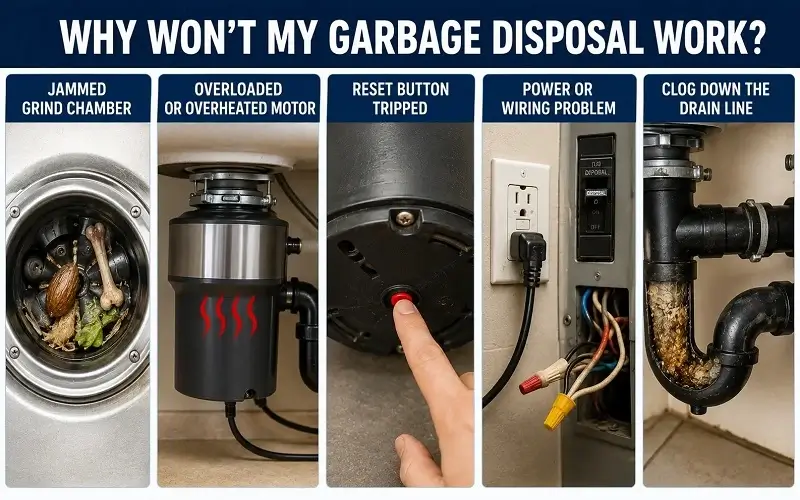
Most disposal problems trace back to one of these:
- A jam in the grind chamber – a fruit pit, a bit of bone, a stray spoon, or fibrous scraps like celery or corn husks can wedge the impellers in place.
- An overloaded or overheated motor – running the disposal too long or feeding it too much at once, trips the internal thermal safety switch.
- A tripped reset button – this is the small red or black button on the bottom of the unit, and it’s designed to trip before the motor burns out.
- A power or wiring issue – a tripped breaker, a loose connection, or a switch that’s simply worn out.
- A clog further down the line – sometimes the disposal itself is fine, but water and waste have nowhere to go because the drain past it is blocked.
Which one you’re dealing with usually comes down to what you hear (or don’t hear) when you flip the switch.
Is It Safe to Troubleshoot a Garbage Disposal Yourself?
For the basics, yes. For anything involving the wiring, the motor, or the mounting assembly, no.
Before touching anything under the sink:
- Cut the power completely. unplug the unit or shut off the breaker. Don’t rely on the wall switch alone.
- Never reach in with your hands, even with the power off. Use tongs, needle nose pliers, or the disposal’s own Allen wrench.
- Skip the chemical drain cleaners. They don’t clear mechanical jams, and they can eat away at the disposal’s internal seals and gaskets.
If you’ve done that and the unit still won’t run, that’s your cue to stop troubleshooting and call for garbage disposal service rather than keep pushing on it.
How Do I Fix a Garbage Disposal That’s Humming or Won’t Turn On?
If it’s humming, clicking, or just silent, walk through these steps in order.
- Cut the power first. Unplug the disposal or flip the breaker before you do anything else.
- Look for a jam with the Allen wrench. Most disposals include a small hex opening on the bottom. Insert the wrench and turn it back and forth to free the impellers manually.
- Clear any visible debris. With the power still off, use tongs or pliers to pull out whatever caused the jam. Never use your fingers.
- Press the reset button. It’s usually a small button on the underside of the unit. Give the motor a minute to cool first if it’s been running hot.
- Restore power and test it. Turn the water on, then flip the switch. If it runs smoothly, you’re done. If it hums, clicks, or trips again, stop here.
What Are the Signs Your Garbage Disposal Needs Professional Repair?
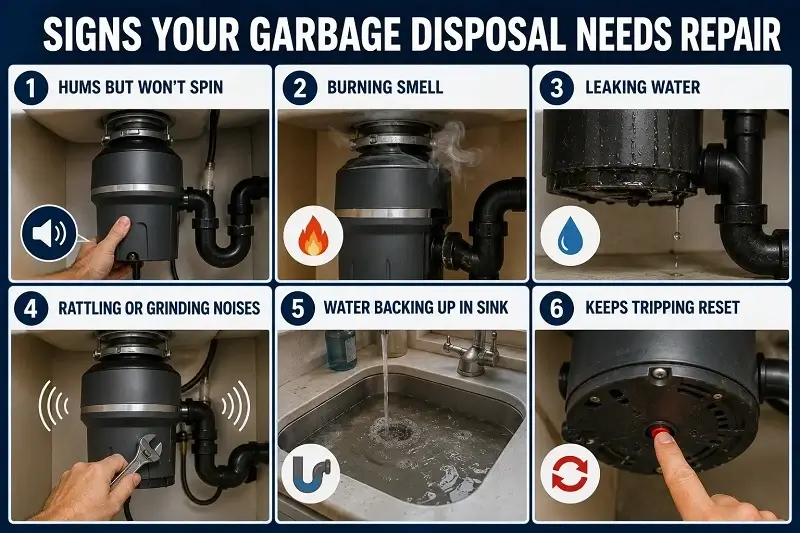
Some problems are worth a five-minute check. Others aren’t worth the risk. Call a plumber if you notice:
- It hums, but the blades never spin, even after clearing a jam and resetting it.
- A burning or scorched smell coming from the unit, which points to a motor on its way out.
- Water leaking from the bottom or the connections, which usually means a worn seal or a cracked housing.
- Rattling or grinding that doesn’t clear up after you’ve removed the obvious obstruction.
- Water backing up into the sink when the disposal runs, which can mean the clog is deeper in the line than the disposal itself.
- It keeps tripping the reset button over and over, even on light use.
Any one of these on its own is worth a call. More than one at the same time usually means the unit is closer to the end of its life than a quick fix.
Can a Garbage Disposal Problem Affect My Septic System?
If your home is on a septic system, and a lot of homes across the more rural parts of Berks County are, this matters more than it does for a municipal sewer connection. According to the U.S. EPA, using a garbage disposal adds solid material to your septic tank and increases how often the tank needs to be pumped, since ground food waste still has to break down somewhere once it leaves the sink.
A disposal that’s struggling, running longer than it should, jamming often, or leaking, can push even more solids and water into a septic system that’s already working hard. If you’re on well water and septic out in areas like Oley, Maxatawny, or Bernville, a disposal issue that seems minor in the kitchen is worth fixing sooner rather than later, before it turns into a bigger septic problem down the line.
When Should I Replace Instead of Repair My Garbage Disposal?
Repair makes sense for a onetime jam or a worn part. Replacement starts to make more sense once you’re seeing the following:
- The unit is 10 years or older, and this isn’t the first repair call.
- Rust or corrosion on the housing or under the sink cabinet.
- Repeated leaks, even after a seal replacement.
- A motor that’s already burned out or won’t reset no matter what you try.
A disposal that’s constantly getting patched up usually ends up costing more over time than one straightforward replacement.
Ready to Get Your Garbage Disposal Working Again?
A humming disposal or a tripped reset button is often a five-minute fix. A leaking, burning, or repeatedly failing one isn’t something to keep pushing through on your own.
Whether you need a quick repair, a full replacement, or just a second opinion before you spend money on the wrong fix, our licensed team is available 24/7 across Reading, PA, and all of Berks County.
Call (484) 332-3573, available 24 hours a day, 7 days a week Or contact us online to schedule your garbage disposal repair.
Frequently Asked Questions
1. Is a garburator the same thing as a garbage disposal?
Yes, “garburator” is simply the term used in Canada and parts of the northern U.S. for the same appliance most Americans call a “garbage disposal” or “food waste disposer.”
2. Why is my garbage disposal humming but not spinning?
The motor is getting power, but something is physically blocking the impellers. Cut the power, use the Allen wrench to free the jam manually, then press reset before trying it again.
3. Can I pour boiling water down a jammed disposal to fix it?
It’s not recommended. Boiling water can warp certain plastic and rubber components inside the unit, and it won’t clear a mechanical jam the way manually freeing the impellers will.
4. How often should a garbage disposal be professionally serviced?
There’s no strict schedule the way there is with a water heater, but if you’re calling about the same issue more than once a year, that’s a sign it needs a closer look rather than another quick fix.
5. What are the most common plumbing issues that come with an aging disposal?
Leaks at the connections, worn mounting seals, and drain line clogs tend to show up together as a disposal ages. If you’re noticing more than one of these at once, our guide to common plumbing issues covers what else tends to go wrong around the same time.
6. Should I call an emergency plumber if my disposal is leaking badly?
If it’s actively leaking under the sink and you can’t stop it by shutting off the water supply to that line, yes, treat it like the emergency it is and call an emergency plumber right away rather than waiting.