
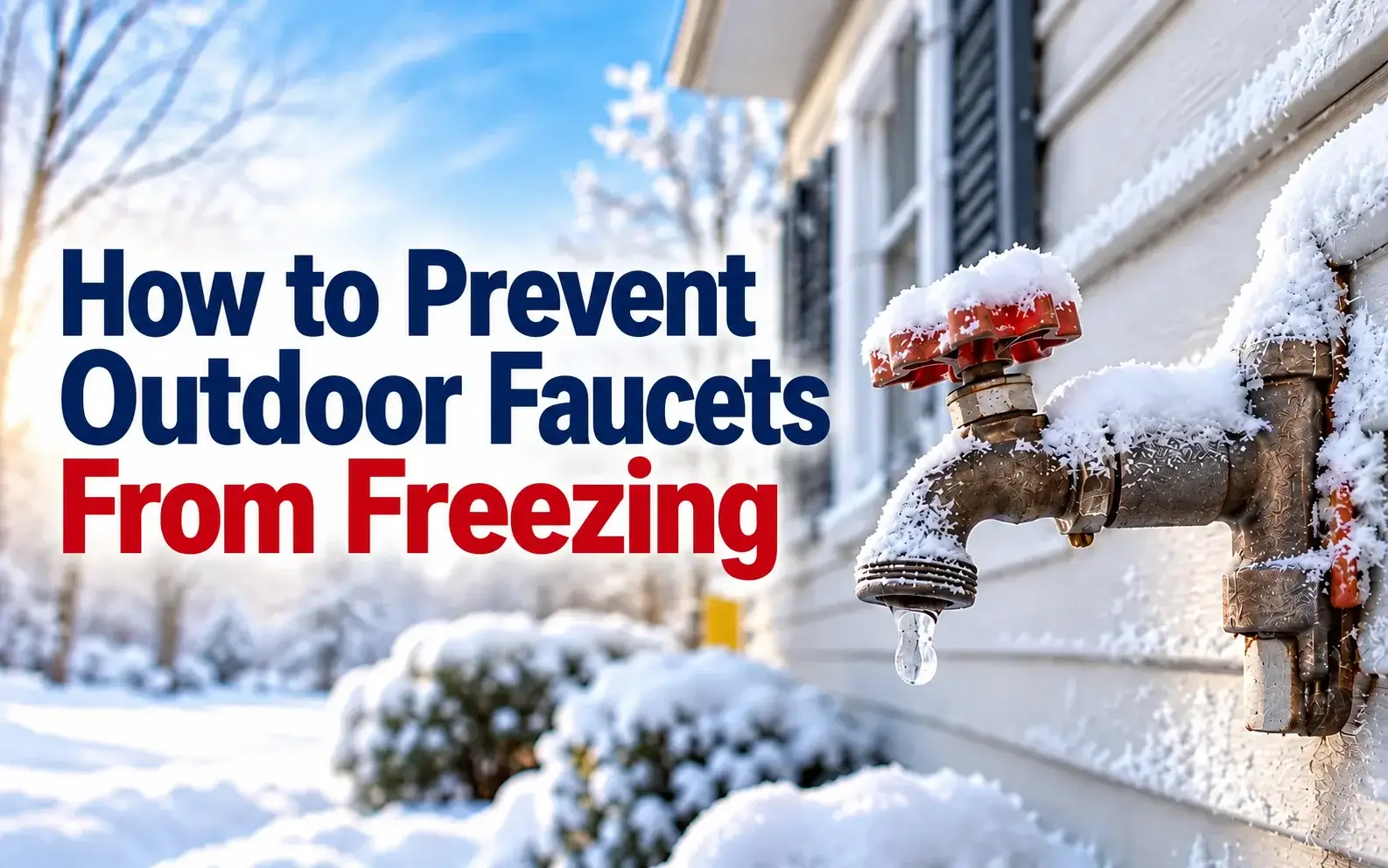

Disconnect your hoses and shut off the interior valve. Drain the line, then cover the faucet before the first hard freeze. No interior shutoff for the outdoor spigot? That’s common in older Berks County homes, and it needs a plumber, not a faucet cover.
Most outdoor faucets freeze because water sits in a line that runs through an uninsulated exterior wall. When that water freezes and expands, the pipe can crack. You often won’t know until the ice thaws and water leaks into your basement or wall. It’s the same freeze-thaw cycle that damages pipes throughout the region each winter. Preventing it is a lot cheaper than repairing it later. A few minutes of prep in the fall can save you that repair call. It’s one part of a complete winterizing checklist worth running through before the first freeze.
Why Outdoor Faucets Are the First Thing to Freeze
Indoor plumbing gets heat from your home. Outdoor faucets don’t. The supply line to an exterior spigot usually runs near an uninsulated wall. It loses heat fast once temperatures drop. Standard hose bibs have no shutoff valve of their own. Water sits in the line all the way to the faucet head unless you drain it. Frost-free (frost-proof) faucets move the shutoff point several inches inside the wall, so the exposed section stays dry. That only works if nothing traps water against the valve, and a connected garden hose does exactly that.
What Temperature Do Outdoor Faucets Actually Freeze At?
Water freezes at 32°F. A pipe with some warmth or insulation usually needs low-20s temperatures for several hours to freeze solid. Wind, a north-facing wall, or an uninsulated line can raise that risk, even in the high 20s. That’s why one cold night in the 30s rarely bursts a pipe. A long cold snap in the teens and 20s is when unprotected faucets fail. That’s common across Berks County in January.
| Outdoor Temperature | Freeze Risk | What to Do |
| Above 32°F | Minimal | No action needed beyond normal fall prep |
| 20°F–32°F, brief exposure | Low, rises with wind or duration | Confirm hoses are off and faucet is covered |
| Below 20°F for several hours | High, especially on exposed or north-facing walls | Line should already be drained; check exposed pipe insulation |
| Below 10°F or multi-day cold snap | Severe | Make sure the interior shutoff is closed and the faucet is cracked open to relieve pressure |
Use this as a general guide, not a guarantee. A poorly insulated line can freeze well above these temperatures. A properly drained one may not freeze at all, even in a hard freeze.
How to Prevent Outdoor Faucets From Freezing: Step by Step
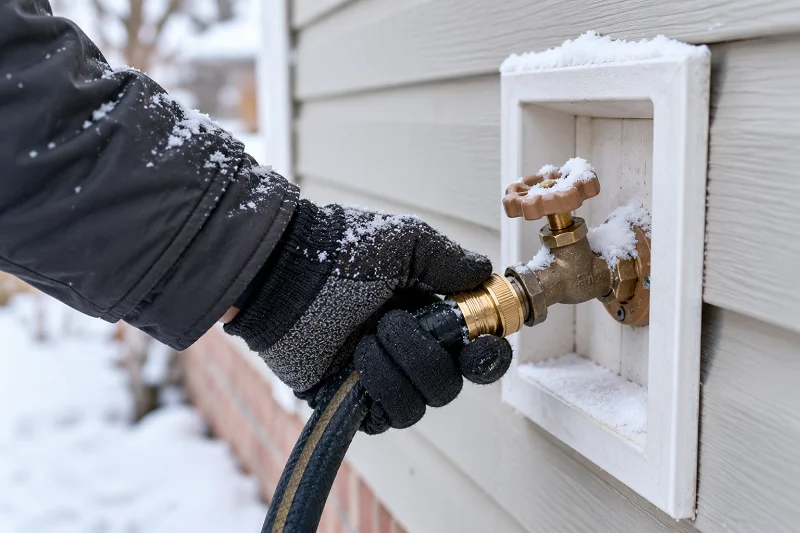
Step 1: Disconnect and Drain Every Hose
A hose left attached traps water against the faucet valve. That trapped water is what splits the pipe, even on a frost-free faucet. Disconnect, drain, and store your hoses before the first hard freeze.
Step 2: Shut Off and Drain the Interior Supply
Does your home have an interior shutoff valve for the outdoor spigot? It’s usually in the basement or crawl space, near where the line exits the house. If so, close it. Then go outside and open the faucet fully to drain any water left in the line. Leave the outdoor faucet open slightly through winter. That gives any leftover moisture room to expand instead of splitting the pipe.
Step 3: Insulate or Cover the Faucet
Foam faucet covers (hard-shell or soft insulated) are inexpensive and sold at most hardware stores. They add a real buffer against wind and cold air. For exposed supply pipe leading to the faucet, foam pipe sleeves or insulation wrap add another layer. In a pinch, you can wrap the faucet in a towel and seal it in a plastic bag. That’s a short-term fix, not a substitute for draining the line.
Step 4: No Interior Shutoff? Call a Plumber
In Reading and surrounding Berks County boroughs, some older homes have outdoor spigots plumbed straight off the main line. They have no separate shutoff. A faucet cover alone won’t protect the line behind it. The better long-term fix is to install a shutoff valve or upgrade to a frost-free sillcock. That saves you from repeating steps 1 through 3 every fall. It’s a job for local plumbing services, not a weekend DIY project.
Not sure if your home has an interior shutoff for the outdoor spigot? Berks Plumbing & HVAC Specialist can check and install one before the next freeze. Call (484) 332-3573.
Should You Drip Outdoor Faucets in a Hard Freeze?
Not usually, and not at 30°F. Dripping is meant for indoor faucets on exterior walls during a long hard freeze. It’s typically recommended once temperatures sit in the teens or low 20s for an extended period. It’s not a routine step at 30°F. For an outdoor faucet, draining and shutting off the line works better. Dripping only helps if the line is still connected to pressurized water, and that defeats the point of winterizing it.
What If a Faucet Already Froze?
Signs include little or no water flow, frost on the visible pipe, or a bulging section. Shut off the interior valve if you have one. Don’t use an open flame or high heat to thaw it. A hair dryer on low, held a safe distance away, is the standard safe method.
If a frost-free faucet still freezes, there are three common causes. The shutoff valve inside the wall may not be seating fully. A connected hose may be trapping water. Or the faucet may have been installed with the wrong slope. These are repair issues for a plumber, not something a faucet cover will fix.
Sometimes damage doesn’t show up right away. With hidden plumbing damage after winter, a hairline crack may only start leaking weeks later. That usually happens once temperatures rise above freezing. Is it more than one faucet? If there’s no water anywhere in the house on a cold night, the problem is likely further upstream.
Call a plumber if you suspect a crack or if water still won’t drain after thawing. Don’t keep testing it yourself.
Suspect a frozen or cracked outdoor pipe? Berks Plumbing & HVAC Specialist offers frozen pipe repair throughout Reading and Berks County. Call (484) 332-3573 to schedule a technician.
Quick Checklist
- Disconnect, drain and store all garden hoses
- Shut off the interior valve for each outdoor faucet, if one exists
- Open the outdoor faucet to drain the line, and leave it cracked open through winter
- Cover or insulate the faucet and any exposed exterior pipe
- If there’s no interior shutoff, have a plumber install one or upgrade to a frost-free sillcock
- Know where your main water shutoff is in case a line freezes anyway
Frequently Asked Questions
Will outside faucets freeze at 30 degrees?
It’s unlikely from a single cold night at 30°F. The real risk starts when temperatures stay in the low 20s or lower. Exposed or north-facing walls make it worse.
Will wrapping a towel around an outdoor faucet keep it from freezing?
Only as a short-term fix. During an unexpected cold snap, a towel sealed in a plastic bag adds some insulation. It’s not a substitute for draining the line. It won’t help if the pipe behind the faucet is still full of water.
How do foam faucet covers actually work?
They trap a layer of still air around the faucet head. That slows heat loss to the cold air outside. A cover protects the faucet itself, but it does nothing for water still sitting in the supply line. That’s why draining the line matters more than the cover.
How do I winterproof an outside faucet?
Disconnect hoses, shut off and drain the interior supply if you have one, and cover or insulate the faucet. If there’s no interior shutoff, a plumber can install one or replace the fixture with a frost-free model.
How do I fix a freeze-proof outside faucet that still froze?
Frost-free faucets that still freeze usually have one of three problems. Either a hose was left connected, the shutoff valve isn’t seating properly, or the installation slope is wrong. These are repair issues for a plumber, not something a cover or insulation kit will solve.