
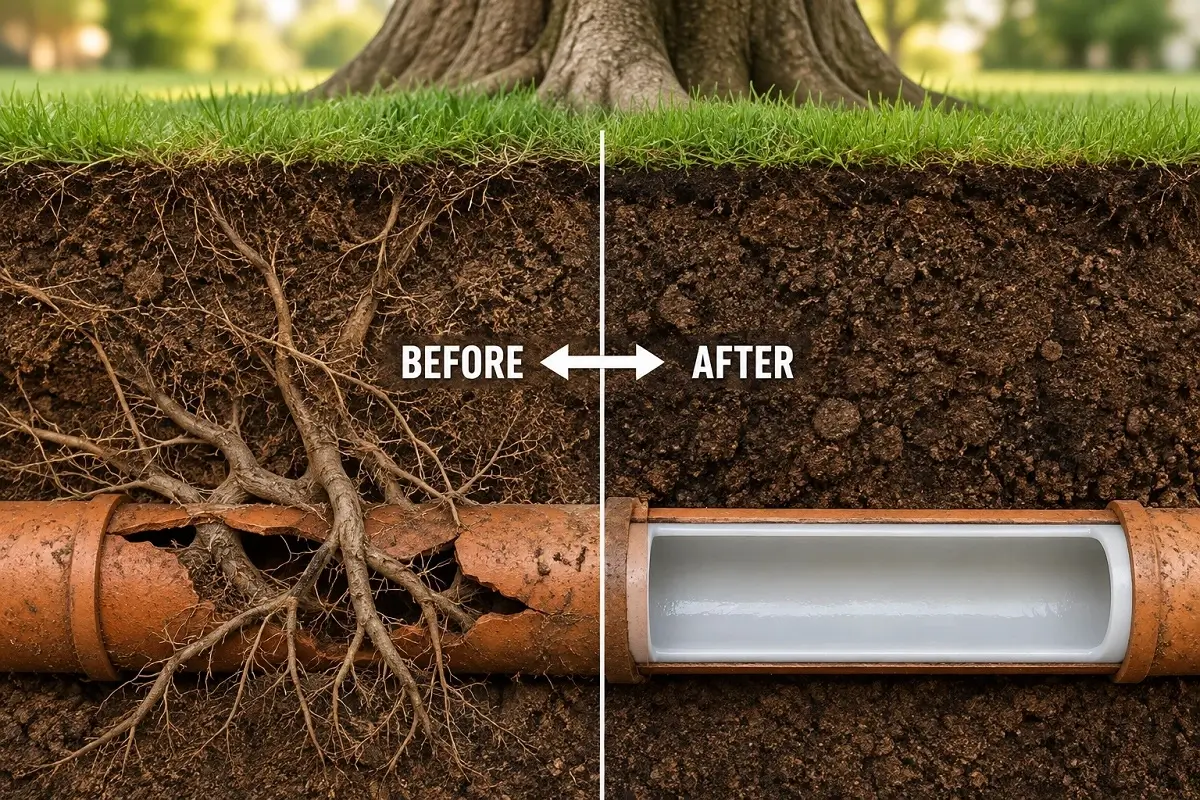

Trenchless sewer repair replaces a damaged sewer line using one or two small access points, not a full dig-up. It minimizes excavation, protects your landscaping, and often finishes faster than traditional sewer repair.
Berks Plumbing & HVAC Specialist uses a method called pipe bursting. It breaks apart the old pipe while pulling a new one through in the same motion. It’s faster and far less disruptive than traditional excavation. But it isn’t always possible — badly collapsed pipes, certain soil types, and some pipe materials still require traditional digging.
If your sewer line has failed, most homeowners ask two questions. First: how do I fix it? Second: does my whole yard have to get torn up? Trenchless sewer repair exists because of that second question. Municipalities and utilities across the country have used it for decades, including right here in Pennsylvania. Understanding how it actually works — not just the sales pitch — is what separates a confident decision from a guess.
According to the U.S. Environmental Protection Agency’s technical fact sheet on trenchless pipe bursting, trenchless methods “provide a method of correcting pipe deficiencies with less disturbance, economic impact, and environmental degradation” than traditional dig-and-replace repair. They also require less restoration work afterward.
How Trenchless Pipe Bursting Actually Works
- Step 1 — Technicians open access points. They dig two small holes, or in many cases use existing manholes, at each end of the damaged section.
- Step 2 — A cable-and-winch system (or in some methods, a horizontal directional drill) pulls a hydraulic or pneumatic expansion head through the existing pipe.
- Step 3 — As the head moves through, it forces the old pipe outward and breaks it apart.
- Step 4 — The system pulls a new pipe in behind it, immediately filling the space where the old, burst pipe used to be.
Per the EPA’s technical fact sheet, pipe bursting can replace pipe from 4 to 24 inches in diameter. Successful projects have ranged from 2 to 48 inches. It can also up-size the new pipe to a larger diameter than the original. That’s useful if the old line was undersized to begin with.
Pros and Cons of Trenchless Pipe Bursting
Pros
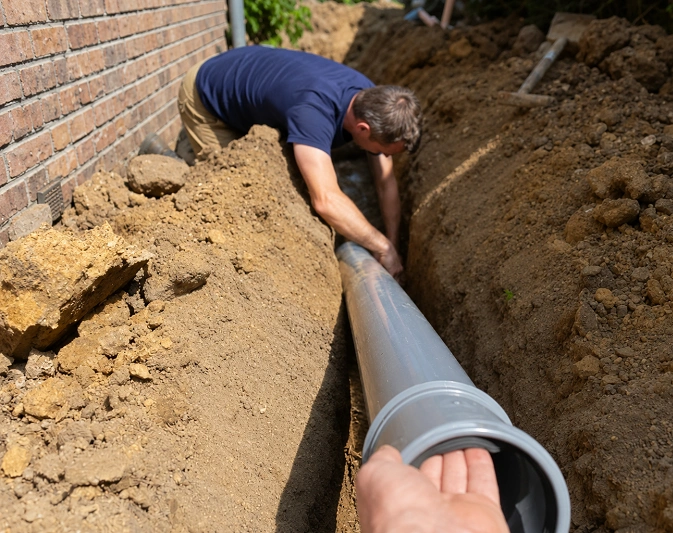
- Far less yard damage. Pipe bursting needs only one or two access points, not a trench along the pipe’s full length. Landscaping, driveways, and hardscaping stay largely untouched.
- Faster completion. Most trenchless jobs finish in a single day; traditional excavation often takes several.
- Durable materials. HDPE pipe used in pipe bursting is built to last decades.
- Documented real-world results. In an EPA-monitored pilot program in King County, Washington, pipe bursting on the Skyway system achieved an 86% reduction in pipe infiltration and inflow. That’s a measured, government-tracked outcome, not a marketing claim.
- Can increase pipe capacity. Pipe bursting can up-size the replacement pipe to a larger diameter than the original. That’s useful if the old line was undersized.
Cons
- Not possible for every pipe. Severely collapsed sections and certain ductile iron or heavily reinforced concrete pipe can rule out bursting. So can pipe running through non-compressible soils like rocky or dense clay.
- Soil and groundwater conditions matter. Moderately compactable soil offers the best conditions for bursting. Densely compacted soil and pipes below the water table both increase difficulty and can rule the method out.
- The crew has to bypass or divert existing flow during the work — something traditional dig-and-replace doesn’t always require.
- Cost isn’t automatically lower. It depends heavily on pipe length, depth, material, and site access.
- Either way, you need a camera inspection first. You can’t skip the diagnostic step, no matter which method you end up needing.
Trenchless (Pipe Bursting) vs. Traditional: Side-by-Side
| Factor | Trenchless (Pipe Bursting) | Traditional (Open-Trench) |
| Yard disruption | Minimal — 1-2 access points | Full trench along pipe’s length |
| Typical timeline | Often completed in a day | 2-3 days without shoring |
| Best for | Intact pipe alignment, compressible soil | Severely collapsed pipe, rocky/incompressible soil |
| Landscaping impact | Largely preserved | Often requires full restoration |
| Diameter changes | Can up-size to a larger diameter | Any size change possible |
| Groundwater/soil sensitivity | Higher — some conditions rule it out | Lower — more adaptable |
Is Pipe Bursting the Right Fit for Your Pipe?
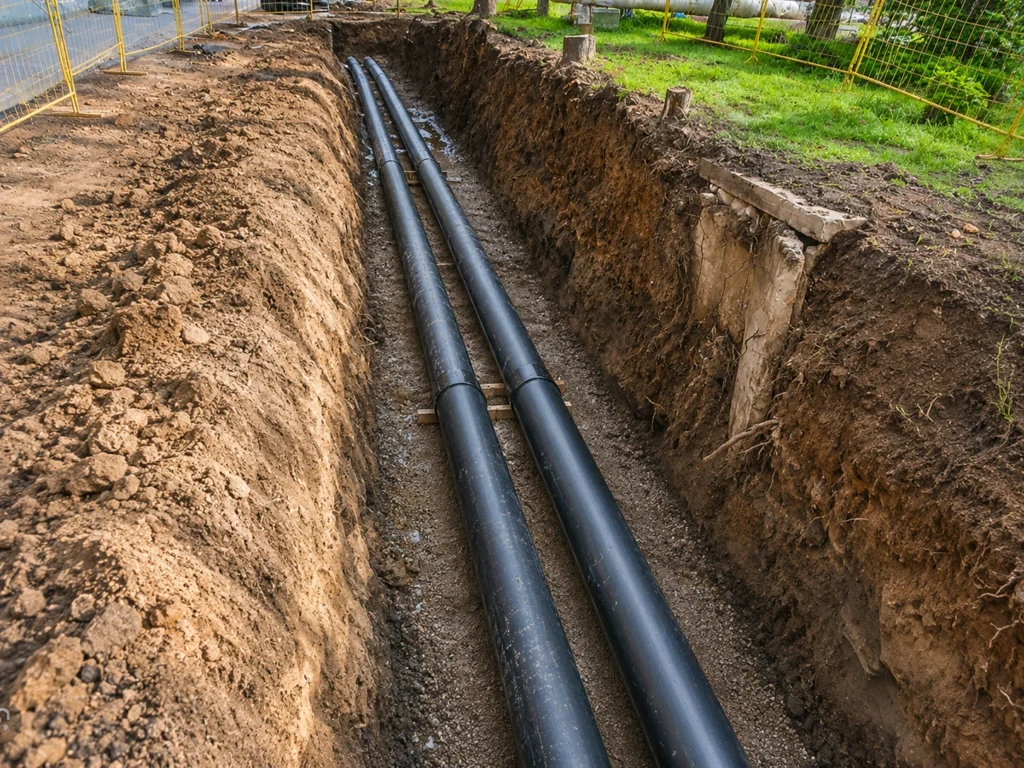
Trenchless isn’t a universal upgrade; it’s a method that fits certain conditions better than others. A camera inspection tells you which situation you’re actually in. It shows whether the old pipe’s alignment can guide a bursting head through, whether the soil is compressible enough, whether the pipe material is compatible, and whether groundwater is a factor. Skipping this step and assuming pipe bursting is the right call often means homeowners end up paying for a diagnosis twice.
What Does Trenchless Sewer Repair Cost?
There’s no honest flat number here — any article that gives you one without an inspection is guessing. Real data can tell us this much: EPA-documented pipe bursting projects have shown construction costs ranging roughly from $73 to $250 per linear foot. That range depends on pipe material, depth, length, and site conditions. Your actual cost depends on your specific line too — length, depth, material, and access. What matters more than the number itself is the diagnostic step that gets you an accurate one: a camera inspection before you choose any repair method.
Who’s Responsible for the Sewer Lateral and Does Insurance Cover Trenchless Repair?
The pipe running from your home to the connection point at the street is called the sewer lateral. In the overwhelming majority of cases, maintaining and repairing it is the homeowner’s responsibility, not the municipality’s. That’s true regardless of whether the fix ends up being trenchless or traditional. Everything past that connection point, into the municipal main, is the city’s problem. Everything on your side of it is yours.
Some Berks County properties, especially in rural areas like Oley and Fleetwood, use private on-site septic systems instead of municipal sewer. For these properties, sewage facility permitting in Pennsylvania falls under the Pennsylvania Sewage Facilities Act (Act 537), which DEP administers through local Sewage Enforcement Officers. That’s worth knowing if your property isn’t on municipal sewer at all.
On insurance: standard homeowners insurance policies generally cover sewer line damage only when it’s sudden and accidental, from a specifically named covered peril. Gradual deterioration, root intrusion, and normal wear — the most common real-world causes of sewer line failure — typically fall outside standard coverage unless you’ve added a separate service line or sewer backup endorsement. Coverage varies by insurer and policy, so this isn’t a substitute for checking your specific coverage; call your insurance provider before assuming either way.
Older Berks County Homes Face This Decision More Often
Reading, West Reading, and Mount Penn have some of the oldest sewer infrastructure in the county. Many lines are clay or cast iron pipe that’s been in the ground for 50+ years, right at the point where structural failure becomes more common. This year’s drought conditions across Berks County add another factor: dry soil shrinks and shifts around buried pipes. That’s exactly the kind of ground movement that can turn a repairable pipe into one needing full replacement. In Oley, Fleetwood, and Maxatawny, older lines on larger rural properties often run longer. That’s where trenchless pipe bursting can offer the biggest disruption savings compared to trenching an entire yard.
Wondering if trenchless pipe bursting is right for your sewer line?
Berks Plumbing & HVAC Specialist provides sewer line camera inspections and trenchless pipe bursting across Reading and all of Berks County.
Call (484) 332-3573 to schedule an inspection.
FAQs
1. Is trenchless sewer repair always cheaper than traditional repair?
Not always. It depends on pipe length, depth, and site conditions. It’s often competitive with or cheaper than traditional excavation once you factor in restoring landscaping, driveways, or sidewalks afterward. But every job is different.
2. Does pipe bursting work on every type of sewer pipe?
Not always. Certain ductile iron or heavily reinforced concrete pipe can rule out bursting. So can pipe running through rocky or dense clay soil. A camera inspection confirms whether your line is a good candidate.
3. Does homeowners insurance cover trenchless sewer repair?
Usually only if the damage is sudden and accidental from a covered peril. Gradual wear, root intrusion, and age-related deterioration are the most common real causes, and standard policies usually exclude them. A separate service line endorsement often covers what standard policies exclude. Check with your insurer directly.
4. Am I responsible for the sewer lateral on my property?
In almost all cases, yes. The section of pipe from your home to the municipal connection point is the homeowner’s responsibility, not the city’s.
5. Can trenchless repair fix a completely collapsed sewer line?
Sometimes, with pipe bursting specifically. But severely collapsed sections, certain pipe materials, and difficult soil conditions can rule it out. A camera inspection is the only reliable way to know.
6. Do I need a permit for trenchless sewer repair in Pennsylvania?
Sewer line work typically requires a permit through your local municipality. Requirements vary by township, so check with your local building or code office. You can also ask your plumber to confirm what your property needs.